Neuigkeiten


·
--
Ed Yardeni Says Investors Are Overreacting to S&P 500 SelloffThe S&P 500 entered correction territory after U.S. stocks fell 3.7% Friday, leaving the index more than 10% below its recent peak after it broke its 200-day moving average. Ed Yardeni, president of Yardeni Research and one of Wall Street’s biggest bulls, said the selloff has gone too far and is a correction rather than a bear market, according to BeInCrypto.
Yardeni cited healthy corporate earnings and cheaper valuations, and still expects the S&P 500 to reach 8,500–9,000 by the end of 2027, though he sees no immediate trigger for a sharp recovery. Last year’s Liberation Day crash reversed after Trump changed course on tariffs, but investors may have to wait longer for a rebound this time. Federal Reserve Governor Christopher Waller said inflation remains a serious concern and raised the possibility of a half-point rate hike in December; markets expect further hikes in December and January. UBS strategist David Lefkowitz also expects slower growth and weaker AI spending. U.S. consumer sentiment rose roughly 7% in November to its highest level since August. Upcoming inflation data and December’s Fed decision will test whether rate hikes push the economy toward recession and undermine Yardeni’s recovery outlook.
Ed Yardeni Says Investors Are Overreacting to S&P 500 Selloff
The S&P 500 entered correction territory after U.S. stocks fell 3.7% Friday, leaving the index more than 10% below its recent peak after it broke its 200-day moving average. Ed Yardeni, president of Yardeni Research and one of Wall Street’s biggest bulls, said the selloff has gone too far and is a correction rather than a bear market, according to BeInCrypto.
Yardeni cited healthy corporate earnings and cheaper valuations, and still expects the S&P 500 to reach 8,500–9,000 by the end of 2027, though he sees no immediate trigger for a sharp recovery. Last year’s Liberation Day crash reversed after Trump changed course on tariffs, but investors may have to wait longer for a rebound this time. Federal Reserve Governor Christopher Waller said inflation remains a serious concern and raised the possibility of a half-point rate hike in December; markets expect further hikes in December and January. UBS strategist David Lefkowitz also expects slower growth and weaker AI spending. U.S. consumer sentiment rose roughly 7% in November to its highest level since August. Upcoming inflation data and December’s Fed decision will test whether rate hikes push the economy toward recession and undermine Yardeni’s recovery outlook.
478
·
--
Wall Street Institutions: Market May Be in a Bull-Market CorrectionAccording to Sina Finance, citing Gelonghui, several Wall Street institutions said the recent sell-off may be a correction within a bull market, rather than a clear sign of sustained deterioration in fundamentals.
Chris Larkin, head of trading at Morgan Stanley’s E*Trade, said the market move appeared to be driven mainly by sentiment, given that the economic and fundamental backdrop remained solid. Based on data through the current correction, the S&P 500 has fallen from a record high into correction territory 15 times since 1983; five of those declines eventually became bear markets, Larkin said.
Deutsche Bank analyst Binky Chadha said the market was “severely oversold,” while economic growth and corporate earnings remained strong.
Wall Street Institutions: Market May Be in a Bull-Market Correction
According to Sina Finance, citing Gelonghui, several Wall Street institutions said the recent sell-off may be a correction within a bull market, rather than a clear sign of sustained deterioration in fundamentals.
Chris Larkin, head of trading at Morgan Stanley’s E*Trade, said the market move appeared to be driven mainly by sentiment, given that the economic and fundamental backdrop remained solid. Based on data through the current correction, the S&P 500 has fallen from a record high into correction territory 15 times since 1983; five of those declines eventually became bear markets, Larkin said.
Deutsche Bank analyst Binky Chadha said the market was “severely oversold,” while economic growth and corporate earnings remained strong.
1
1k
·
--
CLARITY Act Provision Creating SEC Crypto Certification Office Draws Democratic OppositionU.S. Senator Lummis said on the 20th that Democrats had previously called for the SEC to establish a dedicated office overseeing crypto certifications, but voted against a CLARITY Act provision creating one. According to Odaily, the September draft directed the SEC office to receive certification applications, assist with filings and refer them to the relevant departments for review. A list of 126 changes that Republican negotiators described as made at Democrats’ request placed the provision at No. 31; Democrats have not confirmed that account.
A procedural vote on September 15 failed to reach the 60-vote threshold, with the measure receiving 49 votes in favor and 50 against. Forty-four Democratic senators and four Republicans voted against it. Democratic Senator Gallego said negotiations over ethics provisions remained unresolved and questioned whether political donations from the crypto industry were receiving unequal treatment. Democrats are set to take control of Congress in January, making the CLARITY Act’s prospects more difficult.
CLARITY Act Provision Creating SEC Crypto Certification Office Draws Democratic Opposition
U.S. Senator Lummis said on the 20th that Democrats had previously called for the SEC to establish a dedicated office overseeing crypto certifications, but voted against a CLARITY Act provision creating one. According to Odaily, the September draft directed the SEC office to receive certification applications, assist with filings and refer them to the relevant departments for review. A list of 126 changes that Republican negotiators described as made at Democrats’ request placed the provision at No. 31; Democrats have not confirmed that account.
A procedural vote on September 15 failed to reach the 60-vote threshold, with the measure receiving 49 votes in favor and 50 against. Forty-four Democratic senators and four Republicans voted against it. Democratic Senator Gallego said negotiations over ethics provisions remained unresolved and questioned whether political donations from the crypto industry were receiving unequal treatment. Democrats are set to take control of Congress in January, making the CLARITY Act’s prospects more difficult.
1
5
2.2k
·
--
Kalshi Faces Monday Hearing on New York Order It Says Would Shut Down Its Exchange NationwideKalshi faces a Monday New York hearing on Attorney General Letitia James' proposed order, which it says would shut the exchange nationwide. Justice Melissa Crane will hear James' temporary restraining-order request at 11:30 a.m. ET, according to The Block, after a federal judge on Friday rejected the CFTC's second emergency bid to block the state case. James' proposal would bar Kalshi from operating an unlicensed gambling business “within or from New York or to persons in New York,” restrict trading by users under 21 and prohibit campus advertising. Kalshi says the order could force nationwide closure and liquidation of open positions; the CFTC argues federal law preempts state gaming rules.
Kalshi Faces Monday Hearing on New York Order It Says Would Shut Down Its Exchange Nationwide
Kalshi faces a Monday New York hearing on Attorney General Letitia James' proposed order, which it says would shut the exchange nationwide. Justice Melissa Crane will hear James' temporary restraining-order request at 11:30 a.m. ET, according to The Block, after a federal judge on Friday rejected the CFTC's second emergency bid to block the state case. James' proposal would bar Kalshi from operating an unlicensed gambling business “within or from New York or to persons in New York,” restrict trading by users under 21 and prohibit campus advertising. Kalshi says the order could force nationwide closure and liquidation of open positions; the CFTC argues federal law preempts state gaming rules.
1
962
·
--
Goldman Sachs Designs SpaceX Financing Plan to Address AI Chip Debt ChallengeAccording to Sina Finance, Goldman Sachs spent more than a year working on a way for technology companies to buy AI chips without damaging their balance sheets. On Thursday, Goldman Sachs and Apollo Global Management presented a plan that helped SpaceX price $32 billion in bonds combining features of corporate debt and asset-backed securities. The financing is costly for SpaceX but could serve as a model for other technology companies buying chips.
Chips are expensive and have useful lives of only a few years. Companies making large purchases may avoid conventional corporate bonds because additional borrowing could increase their debt and lead to credit-rating downgrades. Asset-backed securities can fund purchases without adding debt that affects the issuer’s credit rating, but the market for these securities has limited capacity.
Chip purchasing demand is estimated at about $1.5 trillion over the coming period, with much of it expected to be debt-financed. The only credit market of comparable scale is the U.S. investment-grade corporate bond market, with about $8.3 trillion outstanding.
People familiar with the matter said Goldman Sachs proposed the structure to SpaceX this summer. A special-purpose vehicle would buy Nvidia chips and issue bonds, with repayments supported by a roughly five-year lease agreement with Musk’s rocket, satellite and AI company. The structure is essentially an asset-backed security.
The notes also share features with conventional corporate bonds, including CUSIP security identifiers, allowing them to be offered to investment-grade corporate bond investors. Buyers included insurers, structured-credit investors, asset managers and pension funds, according to people familiar with the matter.
Goldman Sachs Designs SpaceX Financing Plan to Address AI Chip Debt Challenge
According to Sina Finance, Goldman Sachs spent more than a year working on a way for technology companies to buy AI chips without damaging their balance sheets. On Thursday, Goldman Sachs and Apollo Global Management presented a plan that helped SpaceX price $32 billion in bonds combining features of corporate debt and asset-backed securities. The financing is costly for SpaceX but could serve as a model for other technology companies buying chips.
Chips are expensive and have useful lives of only a few years. Companies making large purchases may avoid conventional corporate bonds because additional borrowing could increase their debt and lead to credit-rating downgrades. Asset-backed securities can fund purchases without adding debt that affects the issuer’s credit rating, but the market for these securities has limited capacity.
Chip purchasing demand is estimated at about $1.5 trillion over the coming period, with much of it expected to be debt-financed. The only credit market of comparable scale is the U.S. investment-grade corporate bond market, with about $8.3 trillion outstanding.
People familiar with the matter said Goldman Sachs proposed the structure to SpaceX this summer. A special-purpose vehicle would buy Nvidia chips and issue bonds, with repayments supported by a roughly five-year lease agreement with Musk’s rocket, satellite and AI company. The structure is essentially an asset-backed security.
The notes also share features with conventional corporate bonds, including CUSIP security identifiers, allowing them to be offered to investment-grade corporate bond investors. Buyers included insurers, structured-credit investors, asset managers and pension funds, according to people familiar with the matter.
2
10.3k
·
--
Unloved Stocks Rally as AI Trade Loses SteamAccording to CNBC, the Nasdaq Composite is down 2.7% in 2026 and has fallen 14% over the past month as the AI trade lost steam, while several out-of-favor non-AI stocks advanced. The Campbell's Company rose nearly 20% over the past month, even though only one of 23 analysts rates it a buy, FactSet data showed. BTIG chief market technician Jonathan Krinsky said low investor ownership and widespread lack of interest could set up the stock for a sharp move higher, with a potential trading-volume area near $30. Clorox also gained roughly 20% over the past month, despite analysts' average forecast for an 11% decline over the next 12 months. JetBlue Airways rose 14%; only one analyst rates the airline a buy, and it faces higher fuel costs. Boston Beer advanced nearly 13% after raising its full-year adjusted earnings guidance in October to $9 to $10.50 per share, above FactSet's $8.90 consensus estimate. Only 6.7% of analysts covering Boston Beer rate it a buy. Lululemon and Prudential Financial also appeared on the list of unpopular stocks that outperformed the broader market over the past month.
Unloved Stocks Rally as AI Trade Loses Steam
According to CNBC, the Nasdaq Composite is down 2.7% in 2026 and has fallen 14% over the past month as the AI trade lost steam, while several out-of-favor non-AI stocks advanced. The Campbell's Company rose nearly 20% over the past month, even though only one of 23 analysts rates it a buy, FactSet data showed. BTIG chief market technician Jonathan Krinsky said low investor ownership and widespread lack of interest could set up the stock for a sharp move higher, with a potential trading-volume area near $30. Clorox also gained roughly 20% over the past month, despite analysts' average forecast for an 11% decline over the next 12 months. JetBlue Airways rose 14%; only one analyst rates the airline a buy, and it faces higher fuel costs. Boston Beer advanced nearly 13% after raising its full-year adjusted earnings guidance in October to $9 to $10.50 per share, above FactSet's $8.90 consensus estimate. Only 6.7% of analysts covering Boston Beer rate it a buy. Lululemon and Prudential Financial also appeared on the list of unpopular stocks that outperformed the broader market over the past month.
590
·
--
EU Proposes Further Cuts to Next Seven-Year Budget to Secure DealThe European Union proposed reducing its next seven-year budget from earlier versions to help reach agreement on the package by year-end, according to Bloomberg.
EU Proposes Further Cuts to Next Seven-Year Budget to Secure Deal
The European Union proposed reducing its next seven-year budget from earlier versions to help reach agreement on the package by year-end, according to Bloomberg.
2
1.1k
·
--
BNK Says Memory Demand Has Peaked, SK hynix Shares Are Not UndervaluedCitrini analyst Jukan said on X that a recent BNK Investment & Securities report concluded memory demand had peaked and SK hynix shares were not undervalued even at their current price. According to Odaily, BNK became the first Korean sell-side firm to downgrade SK hynix from Buy to Hold in late April, and the report effectively assigned a Sell view to the memory industry.
BNK Says Memory Demand Has Peaked, SK hynix Shares Are Not Undervalued
Citrini analyst Jukan said on X that a recent BNK Investment & Securities report concluded memory demand had peaked and SK hynix shares were not undervalued even at their current price. According to Odaily, BNK became the first Korean sell-side firm to downgrade SK hynix from Buy to Hold in late April, and the report effectively assigned a Sell view to the memory industry.
1
1.3k
·
--
Artikel
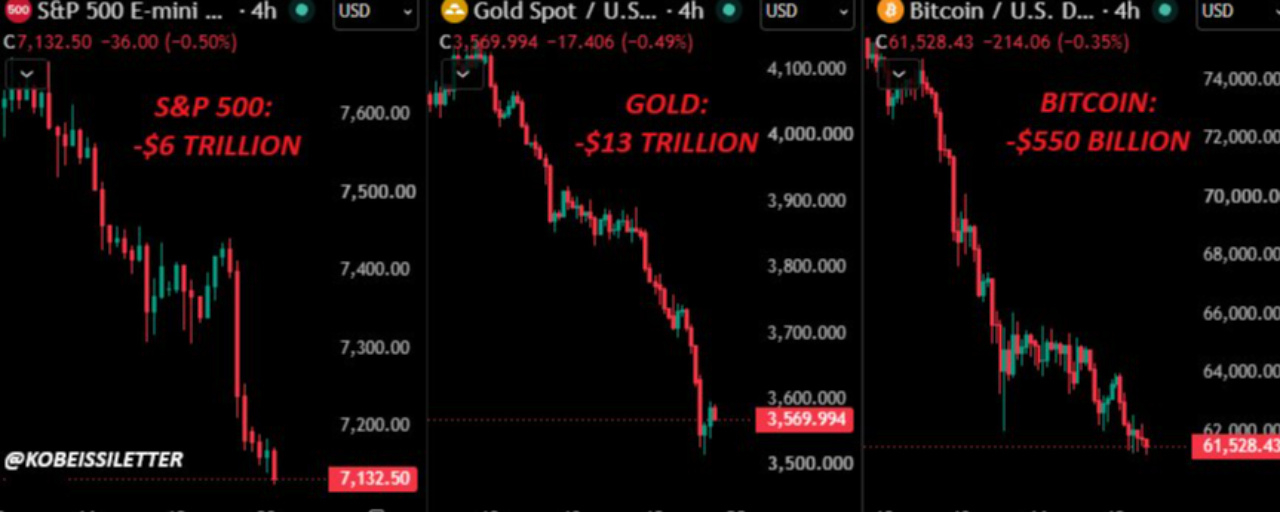
Kobeissi Letter Calls AI Rout a Correction, Not a Popped BubbleUS stocks have lost an average of $225 billion of market value a day for 31 consecutive sessions, and $6 trillion since the S&P 500 last set a record on Oct. 6. The Kobeissi Letter argues in a new note that the move is a normal correction rather than the deflation of an AI bubble.
The research letter points to capital spending as the trigger. Combined capex at Amazon, Alphabet, Meta and Microsoft rose $36.9 billion in the third quarter to a record $201.9 billion, more than double the level of a year earlier and up 356% since the first quarter of 2024. Big Tech has spent $1.6 trillion over three years, and investors have started asking when the returns arrive.
Earnings have held up. S&P 500 companies have reported 31.9% year-on-year EPS growth for the third quarter, the strongest in at least four years, and have beaten estimates for 13 consecutive quarters.
Politics explains another leg of the drop, in the letter's view. It argues the Democratic sweep in the midterms ended what it calls the "Trump Put" — the assumption that the president would step in when markets fell — and that investors now price aggressive AI regulation and even a ban once Democrats take control in January 2027. It calls those fears overdone, on the grounds that a US ban would hand the AI race to China.
The Fed adds pressure. Chair Warsh has made 2% inflation his priority, US inflation has been above target for 67 straight months and the Iran war is nearing its 300th day. Investment-grade bond sales are expected to reach $175 billion in November, up 27% from a year earlier and the highest for that month on record.
Anthropic's IPO drained liquidity at the worst moment. Institutional demand reached $400 billion and retail orders $100 billion, nearly eight times the $64.4 billion the company initially sought at $78 a share.
In chips, Nvidia has fallen 40% in a matter of weeks after the board removed Jensen Huang, and a Nov. 19 short-seller report accused AMD of smuggling chips into China, a claim the letter describes as far from substantiated. Tech's forward price-to-earnings ratio is the lowest since March 2020, and Nvidia trades at 9x, which the letter reads as the market refusing to believe its guidance of roughly $750 billion in fiscal 2028 revenue.
Sentiment gauges are at extremes. The VIX is up more than 100% from its October low and posted its biggest one-day gain since February 2018 on Nov. 5, while hedge funds recorded their largest six-week net outflow from tech in more than a decade.
The letter stops short of calling a bottom, warning that volatility will stay elevated and further losses are possible. It says another 10% decline would still leave the S&P 500 inside the range of a healthy correction, and pushes back on the 30%-plus drop forecasts now circulating. Sustained higher rates, aggressive regulation, weak AI returns and uncertainty around major companies are already in the price, it argues, leaving room for positive surprises. Once liquidity returns, it expects dip buyers to move back into quality tech, as they did in April 2025.
Kobeissi Letter Calls AI Rout a Correction, Not a Popped Bubble
US stocks have lost an average of $225 billion of market value a day for 31 consecutive sessions, and $6 trillion since the S&P 500 last set a record on Oct. 6. The Kobeissi Letter argues in a new note that the move is a normal correction rather than the deflation of an AI bubble.
The research letter points to capital spending as the trigger. Combined capex at Amazon, Alphabet, Meta and Microsoft rose $36.9 billion in the third quarter to a record $201.9 billion, more than double the level of a year earlier and up 356% since the first quarter of 2024. Big Tech has spent $1.6 trillion over three years, and investors have started asking when the returns arrive.
Earnings have held up. S&P 500 companies have reported 31.9% year-on-year EPS growth for the third quarter, the strongest in at least four years, and have beaten estimates for 13 consecutive quarters.
Politics explains another leg of the drop, in the letter's view. It argues the Democratic sweep in the midterms ended what it calls the "Trump Put" — the assumption that the president would step in when markets fell — and that investors now price aggressive AI regulation and even a ban once Democrats take control in January 2027. It calls those fears overdone, on the grounds that a US ban would hand the AI race to China.
The Fed adds pressure. Chair Warsh has made 2% inflation his priority, US inflation has been above target for 67 straight months and the Iran war is nearing its 300th day. Investment-grade bond sales are expected to reach $175 billion in November, up 27% from a year earlier and the highest for that month on record.
Anthropic's IPO drained liquidity at the worst moment. Institutional demand reached $400 billion and retail orders $100 billion, nearly eight times the $64.4 billion the company initially sought at $78 a share.
In chips, Nvidia has fallen 40% in a matter of weeks after the board removed Jensen Huang, and a Nov. 19 short-seller report accused AMD of smuggling chips into China, a claim the letter describes as far from substantiated. Tech's forward price-to-earnings ratio is the lowest since March 2020, and Nvidia trades at 9x, which the letter reads as the market refusing to believe its guidance of roughly $750 billion in fiscal 2028 revenue.
Sentiment gauges are at extremes. The VIX is up more than 100% from its October low and posted its biggest one-day gain since February 2018 on Nov. 5, while hedge funds recorded their largest six-week net outflow from tech in more than a decade.
The letter stops short of calling a bottom, warning that volatility will stay elevated and further losses are possible. It says another 10% decline would still leave the S&P 500 inside the range of a healthy correction, and pushes back on the 30%-plus drop forecasts now circulating. Sustained higher rates, aggressive regulation, weak AI returns and uncertainty around major companies are already in the price, it argues, leaving room for positive surprises. Once liquidity returns, it expects dip buyers to move back into quality tech, as they did in April 2025.
2
2
21
61.5k
·
--
Goldman's Panic Index Hits 9 Out of 10 as Desk Sees More Selling AheadGoldman Sachs' panic gauge climbed close to its maximum as U.S. stocks tumbled Friday, a signal from the bank's traders that another substantial round of selling is likely in the coming week, Bloomberg reported.
The Panic Index rose to 9 out of 10, with the retreat now spanning systematic investors. Commodity trading advisers have sold $57 billion of equities over the past month and their net positioning in U.S. stocks has flipped short by $19 billion, according to Goldman estimates. The bank's models project CTAs could offload another $65.8 billion in a flat market, $28.6 billion if stocks rise, and as much as $80.6 billion if equities keep falling.
Many investors had counted on Anthropic's record listing to revive risk appetite. Instead it failed to deliver the market-wide lift. Traders wrote that the market was looking for the world's biggest offering "to act as a clearing event to usher a 'risk-back-on' trade into year end. Without this force it has been a tough pill to swallow."
Falling prices risk feeding on themselves, because trend-following strategies cut exposure as direction and volatility shift. Questions about whether the spending on AI infrastructure, chips and computing capacity can justify sector valuations have grown louder, compounded by the turmoil at Nvidia that ended Jensen Huang's tenure.
Crowded positioning and momentum strategies have amplified the swings. The Nasdaq 100 fell 5.6% Friday for its worst week since March 2020, and the Philadelphia Semiconductor Index dropped 11%, dragged down by Nvidia, which lost 14% Friday and is down nearly 50% from its Oct. 6 peak.
The damage reached beyond institutional portfolios. Goldman's basket of retail favourites fell 8.9% and its bitcoin-sensitive basket 11%, while its cyclical-versus-defensive basket slipped 3.2% as money moved into defensives.
Goldman's Panic Index Hits 9 Out of 10 as Desk Sees More Selling Ahead
Goldman Sachs' panic gauge climbed close to its maximum as U.S. stocks tumbled Friday, a signal from the bank's traders that another substantial round of selling is likely in the coming week, Bloomberg reported.
The Panic Index rose to 9 out of 10, with the retreat now spanning systematic investors. Commodity trading advisers have sold $57 billion of equities over the past month and their net positioning in U.S. stocks has flipped short by $19 billion, according to Goldman estimates. The bank's models project CTAs could offload another $65.8 billion in a flat market, $28.6 billion if stocks rise, and as much as $80.6 billion if equities keep falling.
Many investors had counted on Anthropic's record listing to revive risk appetite. Instead it failed to deliver the market-wide lift. Traders wrote that the market was looking for the world's biggest offering "to act as a clearing event to usher a 'risk-back-on' trade into year end. Without this force it has been a tough pill to swallow."
Falling prices risk feeding on themselves, because trend-following strategies cut exposure as direction and volatility shift. Questions about whether the spending on AI infrastructure, chips and computing capacity can justify sector valuations have grown louder, compounded by the turmoil at Nvidia that ended Jensen Huang's tenure.
Crowded positioning and momentum strategies have amplified the swings. The Nasdaq 100 fell 5.6% Friday for its worst week since March 2020, and the Philadelphia Semiconductor Index dropped 11%, dragged down by Nvidia, which lost 14% Friday and is down nearly 50% from its Oct. 6 peak.
The damage reached beyond institutional portfolios. Goldman's basket of retail favourites fell 8.9% and its bitcoin-sensitive basket 11%, while its cyclical-versus-defensive basket slipped 3.2% as money moved into defensives.
2.1k
·
--
Japan’s Economy Contracted Slightly in Third Quarter as Rainfall Hurt SpendingJapan’s economy shrank slightly in the third quarter as a record stretch of rainfall from late August weighed on consumer spending, according to Bloomberg.
Japan’s Economy Contracted Slightly in Third Quarter as Rainfall Hurt Spending
Japan’s economy shrank slightly in the third quarter as a record stretch of rainfall from late August weighed on consumer spending, according to Bloomberg.
877
·
--
U.S. Economic Surprise Index Rises to 71, Its Second-Highest Reading Since August 2023The U.S. Economic Surprise Index has risen to 71, its second-highest reading since August 2023. According to Odaily, The Kobeissi Letter said the index has gained 56 points since August this year, an increase of 373%.
The index measures the gap between actual economic data and market expectations: readings above zero indicate data exceeded expectations, while readings below zero indicate it fell short. Excluding data from July and August 2023, the current reading is the highest since the rapid U.S. economic recovery after the pandemic in 2020.
The Kobeissi Letter said the index has been above its current level for about 5% of the past 23 years, which may indicate that growth momentum is building in the U.S. economy.
U.S. Economic Surprise Index Rises to 71, Its Second-Highest Reading Since August 2023
The U.S. Economic Surprise Index has risen to 71, its second-highest reading since August 2023. According to Odaily, The Kobeissi Letter said the index has gained 56 points since August this year, an increase of 373%.
The index measures the gap between actual economic data and market expectations: readings above zero indicate data exceeded expectations, while readings below zero indicate it fell short. Excluding data from July and August 2023, the current reading is the highest since the rapid U.S. economic recovery after the pandemic in 2020.
The Kobeissi Letter said the index has been above its current level for about 5% of the past 23 years, which may indicate that growth momentum is building in the U.S. economy.
2
1.5k
·
--
Banca Monte dei Paschi Says Intesa Sanpaolo Bid Is Fair but Falls Short on ValueAccording to Bloomberg, Banca Monte dei Paschi di Siena SpA said Intesa Sanpaolo SpA’s acquisition bid is fair financially but does not fully reflect the Tuscan lender’s value, days before shareholders begin deciding on the offer.
Banca Monte dei Paschi Says Intesa Sanpaolo Bid Is Fair but Falls Short on Value
According to Bloomberg, Banca Monte dei Paschi di Siena SpA said Intesa Sanpaolo SpA’s acquisition bid is fair financially but does not fully reflect the Tuscan lender’s value, days before shareholders begin deciding on the offer.
1
820
·
--
Moody's: UK Deficit Cuts Unlikely to Reverse Rising Debt TrendAccording to Jin10, Moody's said the UK is reducing its fiscal deficit, but not enough to reverse the continued rise in government debt. Moody's expects the deficit-to-GDP ratio to fall from 5.3% in 2025 to 4.5% in 2026 and 4% in 2027. The UK government's 2027 budget also reflects its commitment to reducing the deficit. However, Moody's expects government debt to rise to 106% of GDP by the end of this decade, while interest rates are expected to remain high relative to government revenue. Moody's said the long average maturity of UK government debt and the country's mature domestic capital markets help limit refinancing and liquidity risks.
Moody's: UK Deficit Cuts Unlikely to Reverse Rising Debt Trend
According to Jin10, Moody's said the UK is reducing its fiscal deficit, but not enough to reverse the continued rise in government debt. Moody's expects the deficit-to-GDP ratio to fall from 5.3% in 2025 to 4.5% in 2026 and 4% in 2027. The UK government's 2027 budget also reflects its commitment to reducing the deficit. However, Moody's expects government debt to rise to 106% of GDP by the end of this decade, while interest rates are expected to remain high relative to government revenue. Moody's said the long average maturity of UK government debt and the country's mature domestic capital markets help limit refinancing and liquidity risks.
1
561
·
--
Moody's: UK Growth Outperforms Expectations, but Inflation and Debt Risks PersistAccording to Jin10, Moody's Ratings said the UK's economic growth in recent years has been stronger than expected, but risks remain. Improved relations with the European Union or stronger AI-related productivity growth could further boost medium-term economic growth, Moody's said. The UK still faces inflationary pressure and rising debt. Moody's said the country's economic outlook could weaken if the government struggles to cut its fiscal deficit, causing debt to grow faster.
Moody's: UK Growth Outperforms Expectations, but Inflation and Debt Risks Persist
According to Jin10, Moody's Ratings said the UK's economic growth in recent years has been stronger than expected, but risks remain. Improved relations with the European Union or stronger AI-related productivity growth could further boost medium-term economic growth, Moody's said. The UK still faces inflationary pressure and rising debt. Moody's said the country's economic outlook could weaken if the government struggles to cut its fiscal deficit, causing debt to grow faster.
2
810
·
--
China’s Top Planner Urges Faster Government Project ConstructionAccording to Bloomberg, China’s top planning agency urged local authorities to accelerate construction of government investment projects and disburse funds faster to spur growth in the world’s second-largest economy.
China’s Top Planner Urges Faster Government Project Construction
According to Bloomberg, China’s top planning agency urged local authorities to accelerate construction of government investment projects and disburse funds faster to spur growth in the world’s second-largest economy.
793
·
--
Vietnam Lawmakers Approve Changes to Speed Land Clearance, Project DevelopmentAccording to Bloomberg, Vietnam’s National Assembly passed amendments to land laws aimed at speeding site clearance and unblocking property and infrastructure projects. The government is seeking to achieve its multiyear target for double-digit economic growth.
Vietnam Lawmakers Approve Changes to Speed Land Clearance, Project Development
According to Bloomberg, Vietnam’s National Assembly passed amendments to land laws aimed at speeding site clearance and unblocking property and infrastructure projects. The government is seeking to achieve its multiyear target for double-digit economic growth.
1
960
·
--
Robinhood Director Baiju Bhatt Sells $4.78M in Stock, Cutting Stake by 94%According to ChainCatcher citing SEC filings, Robinhood director Baiju Bhatt sold 69,387 shares on November 17 at an average price of $69.03 per share, for approximately $4.78 million. After the sale, his direct holdings fell to 4,636 shares, and his ownership percentage declined 94%.
Robinhood Director Baiju Bhatt Sells $4.78M in Stock, Cutting Stake by 94%
According to ChainCatcher citing SEC filings, Robinhood director Baiju Bhatt sold 69,387 shares on November 17 at an average price of $69.03 per share, for approximately $4.78 million. After the sale, his direct holdings fell to 4,636 shares, and his ownership percentage declined 94%.
2.2k
·
--
Hong Kong Bill Proposes HK$100,000 Fine for Unauthorized Crypto Titles, Two-Year Jail Term for Fake License ClaimsHong Kong’s proposed virtual asset legislation would penalize unauthorized use of regulated service-provider titles and false claims of being a license applicant. According to Foresight News, citing Caixin, the 2026 Virtual Asset Service Legislation (Amendment) Bill introduces two offenses to address misleading promotions in the sector.
Anyone who is not licensed or registered but uses titles associated with virtual asset service providers regulated by the Securities and Futures Commission, such as “crypto trader,” “cryptocurrency adviser” or “virtual asset custodian,” could face a HK$100,000 fine upon conviction. Continuing violations would carry an additional HK$2,000 fine for each day they persist.
A person falsely claiming to be a license applicant could, upon conviction on indictment, face a HK$400,000 fine and up to two years in prison. Each day of a continuing offense could bring an additional HK$10,000 fine.
Hong Kong Bill Proposes HK$100,000 Fine for Unauthorized Crypto Titles, Two-Year Jail Term for Fake License Claims
Hong Kong’s proposed virtual asset legislation would penalize unauthorized use of regulated service-provider titles and false claims of being a license applicant. According to Foresight News, citing Caixin, the 2026 Virtual Asset Service Legislation (Amendment) Bill introduces two offenses to address misleading promotions in the sector.
Anyone who is not licensed or registered but uses titles associated with virtual asset service providers regulated by the Securities and Futures Commission, such as “crypto trader,” “cryptocurrency adviser” or “virtual asset custodian,” could face a HK$100,000 fine upon conviction. Continuing violations would carry an additional HK$2,000 fine for each day they persist.
A person falsely claiming to be a license applicant could, upon conviction on indictment, face a HK$400,000 fine and up to two years in prison. Each day of a continuing offense could bring an additional HK$10,000 fine.
1
5
6.8k
·
--
STOCKS | China-Related Stocks Mostly Fall on November 21; TSMC Drops 9.48%, Alibaba 2.68%According to Sina Finance, popular China-related stocks mostly fell on November 21, and the Nasdaq Golden Dragon China Index (HXC) closed down 3.37%. Among stocks ranked by market capitalization, H World Group rose 0.14%. Decliners, also ranked by market capitalization, included Taiwan Semiconductor Manufacturing Company, down 9.48%; Alibaba, down 2.68%; PDD Holdings, down 2.70%; NetEase, down 4.85%; ASE Technology Holding, down 13.84%; Chunghwa Telecom, down 0.95%; JD.com, down 2.89%; United Microelectronics Corporation, down 10.15%; Trip.com Group, down 4.12%; Baidu, down 6.75%; KE Holdings, down 1.97%; ZTO Express, down 0.73%; Tencent Music Entertainment, down 2.41%; Futu Holdings, down 4.80%; Li Auto, down 7.56%; Full Truck Alliance, down 2.65%; New Oriental, down 2.98%; XPeng, down 13.86%; NIO, down 7.89%; BOSS Zhipin, down 1.98%; Vipshop, down 0.56%; WSP Holdings, down 2.05%; Atour Lifestyle Holdings, down 0.94%; Silicon Motion Technology, down 9.56%; Bilibili, down 4.16%; GDS Holdings, down 9.69%; Kingsoft Cloud, down 8.38%; and Pony.ai, down 5.97%.
STOCKS | China-Related Stocks Mostly Fall on November 21; TSMC Drops 9.48%, Alibaba 2.68%
According to Sina Finance, popular China-related stocks mostly fell on November 21, and the Nasdaq Golden Dragon China Index (HXC) closed down 3.37%. Among stocks ranked by market capitalization, H World Group rose 0.14%. Decliners, also ranked by market capitalization, included Taiwan Semiconductor Manufacturing Company, down 9.48%; Alibaba, down 2.68%; PDD Holdings, down 2.70%; NetEase, down 4.85%; ASE Technology Holding, down 13.84%; Chunghwa Telecom, down 0.95%; JD.com, down 2.89%; United Microelectronics Corporation, down 10.15%; Trip.com Group, down 4.12%; Baidu, down 6.75%; KE Holdings, down 1.97%; ZTO Express, down 0.73%; Tencent Music Entertainment, down 2.41%; Futu Holdings, down 4.80%; Li Auto, down 7.56%; Full Truck Alliance, down 2.65%; New Oriental, down 2.98%; XPeng, down 13.86%; NIO, down 7.89%; BOSS Zhipin, down 1.98%; Vipshop, down 0.56%; WSP Holdings, down 2.05%; Atour Lifestyle Holdings, down 0.94%; Silicon Motion Technology, down 9.56%; Bilibili, down 4.16%; GDS Holdings, down 9.69%; Kingsoft Cloud, down 8.38%; and Pony.ai, down 5.97%.
1
1
4.1k
Filtern
Am häufigsten gesucht (6 h)
USDT